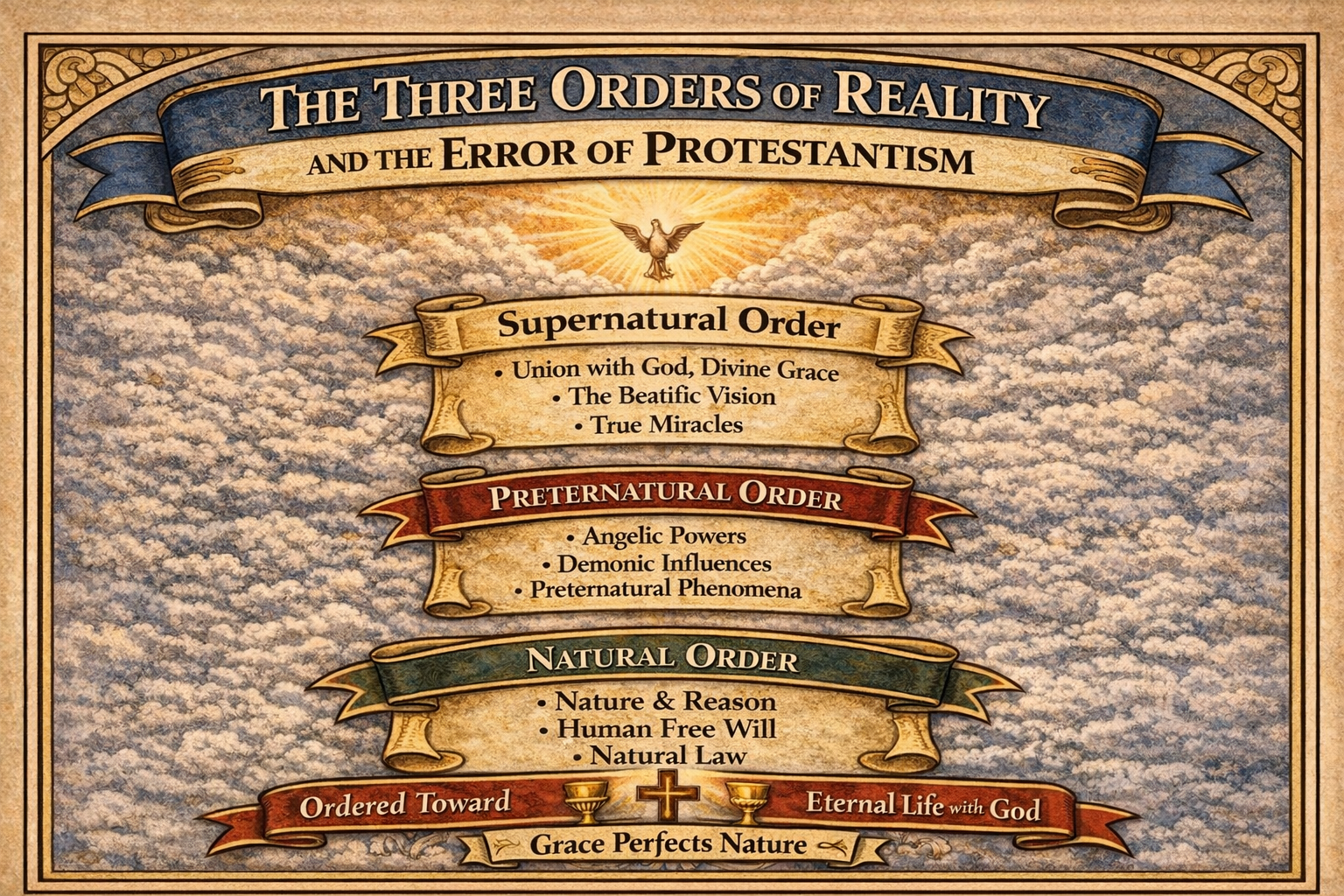
THE THREE ORDERS OF REALITY AND THE ERRORS OF PROTESTANTISM
"Grace does not destroy nature, but perfects it." – St. Thomas Aquinas, Summa Theologiae (Part I, Question 1, Article 8, reply to objection 2)
𝗜𝗻𝘁𝗿𝗼𝗱𝘂𝗰𝘁𝗶𝗼𝗻 –
In order to understand the heart of the Protestant errors it is important to understand their inablity to grasp the order established by God in the world and its consquence upon us and our salvation.
Those who are familiar with the Catholic faith, will grasp well that in fact, it is on this precise topic of nature and grace that we differ not only from the Protestants but from all Non Christian religions.
The Natural Order is the realm of reality governed by created nature and its inherent powers, operating according to laws established by God at creation.
It includes: Matter and physical laws; reason and free will, the natural faculties of the soul - Moral law knowable by reason (Natural Law) -
“The natural law is nothing else than the rational creature’s participation in the eternal law.”
— St. Thomas Aquinas, Summa Theologiae I–II, q.91
Seeking some clarity:
𝗧𝗵𝗲 𝗣𝗿𝗲𝘁𝗲𝗿𝗻𝗮𝘁𝘂𝗿𝗮𝗹 𝗢𝗿𝗱𝗲𝗿
Definition: The Preternatural Order lies above nature but below the supernatural. It includes powers that exceed ordinary natural capabilities but are not divine.
These powers belong especially to: Angels.
Certain extraordinary human phenomena permitted by God
Preternatural Gifts
Being made in the image of God, Adam and Eve possessed the spiritual powers of intellect and will. They were created in a state of innocence and happiness, and enriched with supernatural gifts to elevate, or “divinise,” them and so enable them to participate in the life of God. These gifts included the infused theological virtues of faith, hope and charity, the infused moral virtues of prudence, justice, fortitude and temperance, and sanctifying grace.
In addition to these supernatural gifts, Adam and Eve possessed preternatural gifts to perfect them as human beings, namely, impassability, immortality, integrity and infused knowledge. Their lower instincts obeyed their reason, and their reason obeyed God. All these gifts were gratuitous gifts of God, above our natural rights.
These were not due to human nature, butwere gifts God could give or withdraw.
Angelic Powers – The Angels possess:
Intelligence far superior to man - Power over material things (by God’s permission)
Ability to influence imagination and senses
Demons retain these natural angelic powers but use them maliciously.
Hence, miracles are not preternatural—they are supernatural.
Preternatural acts may appear miraculous, but do not transcend created power.
Dangers of Confusion- Many errors arise here:
Attributing divine power to angels, demons, or humans
Superstition, occultism, spiritism, false mysticism -
Treating extraordinary phenomena as signs of holiness
The Church strictly warns against seeking or trusting preternatural experiences, especially apart from Church teaching or authority.
𝗜𝗜𝗜. 𝗧𝗵𝗲 𝗦𝘂𝗽𝗲𝗿𝗻𝗮𝘁𝘂𝗿𝗮𝗹 𝗢𝗿𝗱𝗲𝗿
The Supernatural Order is entirely beyond created nature. It is the realm of God’s own life, freely shared with creatures.
It includes: Sanctifying grace -
The theological virtues: Faith, Hope, Charity
The sacraments; Supernatural signs Instituted by Christ to give grace.
The supernatural is: - Not owed to any creature – It is entirely gratuitous and impossible to attain without grace.
However it is important to note here that: For God: His life is simply natural to Him. The Trinity is God’s nature.
The supernatural order exists only on the creaturely side. It describes essentially the relation of creatures to God’s inner life.
So: For God: it is just His eternal nature. While for us: it is supernatural elevation.
Thus “supernatural” is a relative term: relative to created nature.
𝗧𝗵𝗲 𝗣𝗿𝗼𝗽𝗲𝗿 𝗥𝗲𝗹𝗮𝘁𝗶𝗼𝗻𝘀𝗵𝗶𝗽 𝗼𝗳 𝘁𝗵𝗲 𝗧𝗵𝗿𝗲𝗲 𝗢𝗿𝗱𝗲𝗿𝘀 - It is important to get it right or else we will make disastrous errors in regards God and salvation.
The Errors of Luther and the Protestants:
The Protestants essentially hold the view of Martin Luther, that is, namely, the view that human nature was radically corrupted by original sin.
Luther held that after Adam’s fall, human nature is essentially ruined: This implied three main things:
• Man is incapable of cooperating with grace
• Free will in spiritual matters is effectively dead
• Even the justified believer remains totally sinful in himself
His famous formula expresses this:
Simul iustus et peccator — simultaneously righteous and sinner.
By this, he implied that :
• A Christian is declared righteous by God (forensic justification), but actually
• He remains inwardly sinful with no real interior transformation.
In short, for Luther, three realities are implied here:
• Grace does not heal or elevate nature
• Grace merely covers sin
• Justification is an external legal declaration, not an internal renewal
So human nature is like:
Snow-covered dung - (the classic Lutheran image): still dung underneath, merely hidden by Christ’s righteousness. This led to his teaching that :
Because of this:
• Good works do not truly please God in themselves
• Sanctification does not change man’s inner being in a real ontological way
• Salvation depends entirely on Christ’s righteousness being imputed, not infused
This is closely tied to Luther’s doctrine of total inability and his rejection of scholastic anthropology.
Luther taught that after the Fall:
Man is totally unable to move himself toward God in any saving way.
More precisely:
· The human will is bound to sin
· Man cannot even desire God rightly by his own powers
· Every act, even apparently good ones, is inwardly corrupted by sin
· There is no cooperation between man and grace in conversion
So:
· You cannot prepare yourself for grace
· You cannot accept grace by free choice
· You cannot resist grace when God gives it
For Luther, God alone acts. Faith itself is not a human response — it is entirely produced by God.
This is why Luther rejected the idea of “free will” in spiritual matters. He famously wrote:
“Free will is nothing.”
He allowed a kind of freedom in earthly affairs (buying, selling, marrying), but in salvation:
· Man is passive
· God is the only actor
Hence total inability: man contributes zero.
Salvation becomes for the Protestant a:
· Monergistic (God alone works)
· Forensic (legal declaration)
· Extrinsic (outside the soul)
Man is justified because Christ’s righteousness is imputed, not because he is internally changed.
“Scholastic anthropology” simply refers to the traditional Catholic understanding of the human person, especially as articulated by St. Thomas Aquinas:
· Man is a unity of body and soul
· The soul has faculties (intellect, will)
· Nature is good but wounded
· Grace perfects nature
· Virtues can be infused
· The will can cooperate with grace (synergy)
Luther rejected this entire framework.
Catholicism teaches that grace is something really present in the soul (habitus).
Luther denied this. Hence for Luther:
· Grace is God’s favor, not a quality in the soul
· Righteousness remains external
Hence for Luther and the Protestants there is no real interior transformation.
Hence for Luther and the Protestants there is no real interior transformation. This is why the Protestant version of the bible mistranslate the words of St. Gabriel to the blessed Virgin Mary from “Hail full of Grace” (something intrinsic to the state of Mary’s soul) - Luke 1:28 to “Hail highly favour one” (something extrinsic).
Traditional Catholic Scholastic theology teaches us that:
· God moves first
· Man freely cooperates
Luther said this was impossible because the will is enslaved.
Hence essentially affirming that :
· No cooperation
· No merit
· No growth in inherent righteousness
Catholic theology on the contrary teaches that :
· The Intellect can know truth - Vatican I’s Dei Filius states that God has given both revelation and reason to humanity.
· The Will can choose good (with grace)
Luther saw the faculties themselves as corrupted: Hence for him
· Reason is unreliable in divine things
· Will is bound to evil
He famously called reason: “the devil’s whore” - When applied to theology.
Regarding the Natural end of our life – Catholic teaching has always point out to us that
Teleology (natural ends)
· Human nature has a real orientation toward God
· There is a natural desire for God
Luther rejected this.
For him:
· Nature has no reliable orientation toward God
· Only external divine action saves
The Catholic response has always been to give us a clear understanding of the orders established by God. In the Catholic view of things, while our nature is wounded, Christ came to heal and elevate our wounded nature by his grace
Hence we can see even in the Old Testament all the graces and blessings which were given by God to men in order to heal that would by means of the blessings imparted, all of which pointed to Christ – as all graces given us essentially would flow from the cross of Christ.
In the Catholic vision of things the soul is essentially transformed “filled with Grace” that Our Lord has poured forth for us on the cross.
Man however must freely choose to cooperates with this grace.
· Faith alone
· Imputed righteousness
· Rejection of sacraments as causes of grace
· Denial of merit
· Loss of ascetic theology – prayer, penance, sacrifice as foundations for the spiritual life.
· Collapse of traditional virtue ethics – Traditional Catholic moral values as essential for keeping the friendship of God.
Everything flows from his false view of nature.
The Catholic Response:
Catholic theology teaches something fundamentally different:
1. Nature is Wounded, Not Destroyed
After the Fall:-
Man still retains:
This is why the Church rejects “total depravity.”
2. Grace Heals and Elevates Nature
Catholicism teaches:
Grace does not destroy nature, but perfects it.
So grace:
Justification is not merely legal:
3. The Justified Are Truly Changed
Catholics deny simul iustus et peccator in Luther’s sense.
Instead:
So the believer is not “covered dung,” but actually washed.
In Short – Luther erroneously believed that :
Catholic Church:
Conclusion:
Not only is it important to grasp the distinction in the three orders established by God, but it is important to grasp the order of each and their relation to each other. Our nature was never destroyed, it was wounded, Christ came to heal it and in the parable of the good Samaritan (Luke 10:25-37) Christ highlights this point; in seeking the healing of the man who was robbed and healed. We have been robbed by both original Sin and actual sin (mortal sin) of God’s sanctifying grace, but we are not dead completely to it, hence the reason for Christ’s healing touch and power to be able to forgive us and transform us by His divine power, thus elevating us to be true sons and daughters of God and “if sons, heirs also; heirs indeed of God, and joint heirs with Christ.” ! (Romans 8:17).