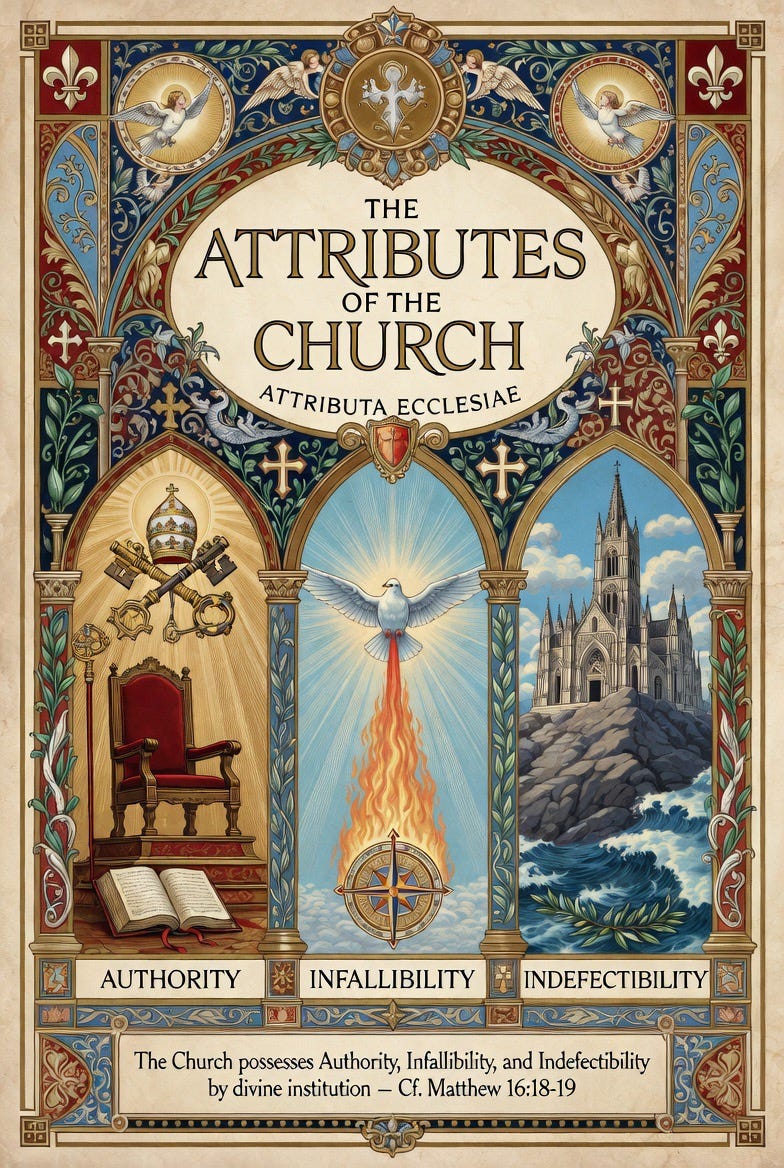
The Three Attributes of the Church
The Church possesses supreme spiritual authority, conferred directly by Our Lord Jesus Christ. This authority encompasses the power to teach doctrine, enact laws for the governance of the faithful, and administer the sacraments. It is exercised through the hierarchy established by Christ: the Pope as successor of St. Peter and the bishops in union with him.
This authority is symbolized by the Keys of the Kingdom given to St. Peter (Matthew 16:19) and the command to “make disciples of all nations… teaching them to observe all that I have commanded you” (Matthew 28:19–20). It is not arbitrary but divinely delegated, enabling the Church to bind and loose, to declare truths of faith and morals, and to guide souls toward salvation. In practice, this manifests in the ordinary and universal Magisterium, canon law, and the pastoral governance of the Church.
Infallibility is the supernatural charism by which the Church is preserved from error when she teaches definitively on matters of faith and morals. This protection is not due to human wisdom but to the assistance of the Holy Spirit, whom Christ promised would “guide you into all the truth” (John 16:13).
Infallibility operates in two primary ways:
Papal Infallibility: When the Roman Pontiff speaks ex cathedra (from the chair of Peter), defining a doctrine concerning faith or morals to be held by the whole Church, he possesses the same infallibility with which the divine Redeemer endowed His Church.
The Infallibility of the College of Bishops: When the bishops, in union with the Pope, teach a doctrine as definitively to be held, either in an ecumenical council or through the ordinary universal Magisterium.
This attribute ensures that the Sacred Deposit of Faith remains intact and is authentically transmitted across generations.
Indefectibility:
Indefectibility refers to the Church’s perpetual endurance and preservation in her essential constitution and mission. Established by Christ upon the rock of Peter, the Church “will not be overcome by the gates of hell” (Matthew 16:18). She will never defect from the true faith, cease to exist, or be replaced by another institution as the means of salvation.
This attribute guarantees that, despite periods of trial, internal weakness, or external persecution, the Church will remain visibly one, holy, Catholic, and apostolic until the Second Coming of Christ. It does not imply that every member or every leader will be free from sin or error in their personal conduct, but that the Church as a divine institution will never lose her identity or her salvific purpose.
Pius XII: 2 June 1944
“Mother Church, Catholic, Roman, which has remained faithful to the constitution received from her Divine Founder, which still stands firm today on the solidity of the rock on which his will erected her, possesses in the primacy of Peter and of his legitimate successors the assurance, guaranteed by the divine promises, of keeping and transmitting inviolate and in all its integrity through centuries and millennia to the very end of time, the entire sum of truth and grace contained in the redemptive mission of Christ.”
Indefectibility = unable to fail – As a whole not in every individual – entire nations may fall , but never the Church as a whole. It will endure forever.
1. The duration of the Church is established by Christ till the end of the world.
2. There will be no essential change in properties, doctrinal or moral teachings, i.e., there will be no corruption. Even if there will be so in individuals and even certain Roman pontiffs.
3. Indefectibility is with respect to the universal society of the Church and does not prevent particular Churches from failing, or for the Church to change in accidentals ways.
Matthew 16, 18 “And the gates of hell shall not prevail against it.”
Matthew 28, 20 “And behold, I am with you all days even to the consummation of the world.”
This is the role of the Holy Ghost – To Guide and uphold the Church
It is important to keep these things in mind especially now when we hear so many perverted things from members in the hierarchy in the Church who to a greater extent appear to be apostate in clerical garb.
Empires and Kingdoms have come and gone. – The Church has endured the most fearsome persecutions in human history – And yet, she alone has endure the test of time, because She is of divine origin. Founded on the Blood Christ, the eternal son of God.
Christ loves His bride the Church more than we would ever love any human being. He is faithful to his Promise “I will be with you always, even until the end of time”! – We can always take heart in that !
Pius IX “No one can deny or cast doubt on the fact that Jesus Christ Himself, in order to apply to all generations the fruits of his redemptive work, has here on earth built on Peter his one Church, that is, the one, holy, Catholic, apostolic Church - and that He has conferred on her all necessary power to keep in its integrity and its purity the deposit of faith, so as to transmit this same faith to all men, to every race, and to every nation, so that all men would become by baptism members of his Mystical Body, and that in them the new life of grace would ever be kept and make more perfect, since without it no one can ever merit or obtain eternal life; finally, so that this same Church, which constitutes His Mystical Body, would remain stable and unchanged in her own nature to the end of time, so that she would ever prosper and be able to furnish all her children the means to work out their salvation.”[1]
[1] Pope Pius IX Letter Jam vos omnes, September 13, 1868 to Protestants and other non-Catholics
4. It reminds us that Church, like it’s founder has an inner and divine life - In the case of the Church, she is moved and animated by the Holy Ghost, who is faithful to His spouse.
5. The Church while being indefectible and divinely founded, has a human element which are deflectable, namely in its members, that is the faithful and clergy who individually make up membership here on earth of the Church can, in rejecting the animating power of the Holy Ghost, not only sin, but even fall away all together. - Two aspects human and divine.
Dom Guerange explains: “God supports directly the Church; and every man of good faith able to apply the laws of analogy can read in the facts which directly concern the Church, the immortal promise of everlasting written by God from its beginning; (Yes) Heresies, scandals, defections, conquests and revolutions, nothing can destroy it; pushed out of a country, the Church moves forward in another one; always visible, always Catholic, always conquering and always severely tested. . . . Don’t we ever isolate Jesus Christ from History of humanity; in our judgements and narrations let’s see History of humanity in relation to Jesus Christ. Let’s remember that when we look at a map of the world, we are looking at the empire of God made man and His Church.”
The Catholic Church like it’s divine master is going to be a sign of contradiction. In this aspect, the conciliar Church has betyrayed the Church they refuse to be that sign of contradiction. Here I will simply cite that great English Historian Hiliare Belloc:
The Catholic Church of its nature excites either great loyalty or repulsion. When it excites repulsion in a man, that man is the enemy of the Faith, even though he accept the greater part of its doctrine and the greater part of its traditional externals”
Pius XI “It is therefore necessary not only that Christ’s Church exist today and always, but also that she remain identical with what she was in the Apostolic age, unless we wish to say - which God forbid! - either that Christ our Lord could not accomplish his design, or that He erred when He affirmed that the gates of hell should never prevail against her.”[1]
Taken as a whole:
These three attributes are intimately connected: authority is exercised infallibly in doctrinal matters and is indefectibly preserved until the consummation of the world. They underscore the Catholic conviction that the Church is not merely a human organization but the Mystical Body of Jesus Christ, sustained by divine promise. “The Church is not a continuous phenomenon through history, rather, it is something that has been through a thousand Resurrections after a thousand crucifixions. The bell is always sounding for its execution which, by some great power of God, is everlastingly postponed” (Venerable Fulton J. Sheen).
[1] Pius XI Encycl. Mortalium animos, January 6, 1928 - True Unity