Disciples of Muhammad from the composition of the
Koran
,
Chapter
13
|
|
Since, therefore,
it has been shown
that the
Koran, which is the law of the Saracens, is not from God, we must
consequently inquire about the disciples of Muhammad and the institution
of the aforementioned Koran. |
|
(6) And it
should be known that it is firmly believed by wise men, and is proved by
effective reasons, that the principal actor of the Quran itself was not
a man but the devil, who, out of his own envy and divine permission
because of the sins of the people, prevailed to solemnly and effectively
initiate the perfidy of the Antichrist. |
|
(11)
Therefore, seeing that the faith of Christ was growing in the parts of
the East and that idolatry was declining
, after the idolatrous king of the Persians and Medes, Cosdrohe, had
been defeated
by the most Christian king Heraclius, and that Heraclius himself had
destroyed the lofty tower which Cosdrohe himself had built of gold and
silver and precious stones because of idolatry, and that the cross of
Christ had already been exalted by Heraclius and was to be exalted still
further
, since the devil himself could no longer defend many gods nor could he
completely deny the law of Moses and the gospel of Christ which had
already been spread throughout the world, he thought of deceiving the
world by the fabrication of a certain law, as if halfway between the new
and the old. |
|
(20) And to
carry this out he took on a certain devilish man named Mahomet
, an idolater by custom, poor in fortune, very proud in mind and famous
for his evil deeds. And indeed the devil would have gladly taken on a
man with a good appetite, if he had been permitted; just as he would
have gladly first tempted |
208r
| man by another animal in which his malice was more concealed than by a
serpent, if he had been permitted. But divine wisdom did not permit him
to take on such an animal and invade the world by such a man, so that
the world could easily see what kind of law was given by such a
lawgiver. |
|
(29)
Therefore, after Cosdros was defeated by the aforementioned Heraclius
and the holy cross was brought back to Jerusalem with a triumph, in the
year of our Lord 626
- but in the fifteenth year of Heraclius - the Arab Mohammed arose. He
first became rich through a certain rich widow whom he had taken as his
wife
, and later, having become the leader of robbers, he burst into such
pride that he wanted to become king of the Arabs. But because they did
not receive him, because he was of low birth and opinion, he pretended
to be a prophet; and because he was epileptic and, as is firmly
believed, convulsive
and frequently fell, he said that an angel spoke to him, and afterwards
gave certain answers, which - as he said - he heard as if in the manner
of a bell
. And because he was an ignorant man without letters, the devil gave him
companions suitable to himself, certain heretical Jews and heretical
Christians. |
|
(41)
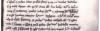 For a certain
Jacobite, named Baheyra
, adhered to him
, and was with
Muhammad almost until his death, and it is said that Muhammad afterwards
killed him; and some Jews, namely, Phineas
and Abdia named Salon, afterwards called Habdalla named Sellem, and
became Saracens
; and some Nestorians, who agree most with the Saracens, saying that God
was not born of the blessed Virgin, but the man Jesus Christ
. And then Muhammad composed some in the manner of a law, receiving from
his companions some from the Old Testament and some from the New
, and yet the
people did not then have the Koran
.
For a certain
Jacobite, named Baheyra
, adhered to him
, and was with
Muhammad almost until his death, and it is said that Muhammad afterwards
killed him; and some Jews, namely, Phineas
and Abdia named Salon, afterwards called Habdalla named Sellem, and
became Saracens
; and some Nestorians, who agree most with the Saracens, saying that God
was not born of the blessed Virgin, but the man Jesus Christ
. And then Muhammad composed some in the manner of a law, receiving from
his companions some from the Old Testament and some from the New
, and yet the
people did not then have the Koran
. |
|
(50) However, it is
narrated in their
histories
that Mohammed said: The Koran descended upon me in
seven men ,
and whatever is sufficient is sufficient. But they say that these were
Nafe and Ehou Homar and Homra and Helkessar and Asser and the son of
Kecir and the son of Amer
. We will therefore say to them: Did they never read |
208v
| before Mohammed? And it will be said that no, but these before the
elders and so on down to Mohammed. And it is certain that these did not
agree with the previous elders in the reading that they now hold; which
is proven because the reading of the first part is contrary to the
second part, because from the time of Mohammed no one knew the Koran
except Abdalla the son of Messecud and Zeid the son of Thabet and
Hocanan the son of Hoffan and Hebi the son of Chab. Of Hali the son of
Abitaleb, some said that they knew part, some did not. |
|
(60) But each
of these men set up for himself a chorale unlike the chorale of the
others, and they fought against each other, not accepting the others
until death. And after their death, the people disagreed about the
chorale until the time of Merebam the son of Elhekem, who composed for
them this chorale which they now have, and burned the other chorales. |
|
(66) And then also
the seven
said prefects of the cities contradicted each other in their own grammar
and idioms
. But from their histories we find that the chapter
of Repudiation
exceeded the chapter
of Vacce
. The first was in 200
tis
.xxx ta
sentences, which today consists only of twelve. They also say that the
chapter of
Vacce once
contained a thousand sentences, and today only 200
tas
.lxxxvij
tem . They
also report about a certain powerful man, named Elgag, that he
subtracted 85 sentences from the Alchoran, and added as many others of a
different meaning
. |
|
(73) How then
is it true that God said of the Koran, as they say, that "we have caused
the remembrance to descend, and we shall be the keepers of it"? They
also relate some stories that Mohammed died of poison
and the people did not have a Koran
. But when
Hebeubeker assumed the principality, he ordered that everyone should
remember what he could, and he composed the Koran that is in his hands,
and he burned the rest
. |
|
(80) But in the chapter
Elhamram
he says about the Quran that
“ no
one knows its interpretation except God. And those who are founded in
knowledge say: We believe in it, for it is all from our God.
”
And indeed there are many things in this book that are so obscure, so
truncated and disordered - as was clear
above
- that they make no sense, but rather are covered up by folly and lies
.
|
|
(85) But it happened
that they agreed that this is the Koran which they have before their
hands, and they said that God revealed it to Muhammad and he himself
wrote it from the mouth of God. However,
the Elfocaha
, that is, the great teachers and expositors
, |
209r
| have never agreed in the exposition of it and will never agree; and
this not only Easterners from Westerners, but also Easterners from each
other and Westerners from each other. And in the same schools there are
different sects and so different that one condemns the other
. |
|
(92) For some
follow Muhammad, and these are the majority; and some follow Haali
, and these are the fewest and less evil, and they say that Muhammad
usurped for himself by tyrannical power what belonged to Haali. But some
Saracens, experts in philosophy,
rose up
against both of them, and began to read in the books of Aristotle and
Plato, and began to despise all the sects of the Saracens and the Quran
itself
. |
|
(98)
A certain caliph of Baldacco, named . . . , having noticed this, built
in Baldacco
the most solemn schools of Nadamya and
Mestanzeria
, and reformed the study of the Quran and ordered that from whatever
provinces they came to Baldacco to study the Quran
, the students should have cells and the necessary stipends from the
commons. And he ordered that the Saracens and those attending the Quran
should in no way study philosophy; nor do they consider those Saracens
who attend philosophy to be good because all such people despise the
Quran for the reasons stated above in
the eighth
and
ninth
chapters. |
Cf.Contrarietas
alpholicaVI,Paris
BN lat. 3394,f. 244r, 8-11: «Sixth chapter. On the disciples of Machomet
and the discord of the institution of Alchorani».
[2]
Cf. St. Augustine,
De Civitate Dei
XVIII, 51 (PL 41, 612-614; CCS 48, 648-652), with an analogous description.
[3]
Les Medes et les Perses ne sont
pas idolâtres mais Mazdéens.
[4]
Cf. JACQUES DE VORAGINE,
Legenda Aurea ,
chap. 137: «On the exaltatione Sanctae Crucis» (ed. TH. GRAESSE, Leipzig. 1850,
p. 605 sqq.).
[5]
Cf.
Pietro il Venerabile
(†
1156), Summa totius haeresis Saracenorum
, ed. J. Kritzeck, Peter the Venerable and Islam, Princeton 1964, pp.
208-209.
The Sainte Croix was reported
to Jerusalem on March 21, 629; Cf. JACQUES DE VORAGINE,Op.
city, p. 608
27.III.2011: commas matter,
that's how!
The editor
Mérigoux interjected
and intended: «
Deuicto igitur Cosdrohe per suprapradictum Eraclium et reportata sancta Cruce in
Ierusalem cum triumpho anno Domini sexcentesimo uigesimo sixtho, Eraclii autem
anno quinto decimo, surrexit Mahometus arabs
», where 626 would be the year
of the restitution of the cross to Jerusalem; hence the corrective clarification
«La Sainte Croix fut rapportée à Jérusalem le 21 mars 629»
. I think
instead that the chronological denotation
«
anno
Domini sexcentesimo uigesimo sixtho
» is to be connected not with
the preceding absolute ablatives but with the main proposition «
surrexit
Mahometus arabs ».
[7]
Encycl. de l'Islam
, 2 a
ed., "
Khadîdja ".
[8]
Uguccione da Pisa
[† 1210]
,
Derivations II, 371: epilemsia, epilemsicus, epileticus
; II, 1036 §28: «whence arreptus -a -um and here arreptim and
arrepticius -a -um, that which arripit or that which is arreptum est, as
demoniacus or demoniaca is properly called arrepticius or arrepticia».
[9]
Cf. R. Blachere,
Le problème de
Mahomet
, p. 40; L.
GARDET, Dieu et la
destiny de l'homme ,
pp. 177-178 and note 2.
[10]
Baheyra: Bah
î râ praem. in Arabic letters Cf. Planche
V (in
questa partial reproduction, guarda con attenzione al centro del rigo
centrale!).
Le nom du moine Bahîrâ
est écrir ici avec un
alif t
awîla final, ce qui
trahirait une vocalisation syriaque (
bhîrâ,
savant), c'est l'ortographe "chrétienne"
de ce nom. Les Musulmans eux, écrivent ce nom aver un
alif maksûra
; Cf. IBN HISHAM,
al-sir at
al-nabawiyya
, Le Caire 1955, p. 180. Riccoldo a du recevoir beaucoup des chrétiens d'Irak
pour son initiation à la culture orientale; CLS 6, line
68
; Planche V.
[11]
Phinehas
: cf.
U. MONNERET DE VILLARD,
Il libro della peregrinazione
nelle parti d'Oriente di frate Ricoldo da Montecroce
, Roma (S. Sabina) 1948
, 109 note 467.
E per i molti antroponimi
arabi qui di seguito non hai che leggere la relative voci in
Encycl. of Islam.
[12]
Cf.
Contrarietas alpholica
V,
Paris BN lat. 3394, f.
243v, 8-15: «A certain monk named Boheira joined him, and he was the first to
join him, and became his teacher and promoted him in the reading of books, and
informed him of what would happen to him concerning his deed, and he assumed
that he would become the bearer of his estate after him, and he was with
Muhammad almost until the death of Muhammad. It is reported that he killed him
and Phineas the Jew in one night in their beds; and Salon the Persian and
Abdalla the son of Selam the Jew joined him and became Saracens»; CLS 6, note
20 .
[13]
Cf.
Libellus ad nationes orientales,
BNF,
Conv. suppr
. C 8.1173, f.
220r : « The
Nestorians seem to be most distant from us concerning the incarnation of Christ
and to be in the greatest agreement with great heretics, who have specially
erred concerning the divinity of Christ, and especially with Arius, Cerinthus,
Ebio, Paulus Senositano, Photinus, and Maccometus »; Itinerarium ,
pp. 127-131 =
Liber peregrinationis , Berlin, Staatsbibliothek lat.
4°.466, ff.
14rb ss.
[14]
Cf. D. MASSON, Le
Coran, et la révélation judéo-chrétienn
e, Paris 1959; J. JOMIER,
Bible and Koran ,
Paris 1958; R. BLACHERE,
Le Coran , Paris
1966, pp. 15-31. CLS 13, r.
76 .
[15]
These are the seven canonical
readers of the Koran: Nafi', Abû 'Amr, Hamza, al-Kisâ'î, 'Asîm, Ibn Kathîr, Ibn
'Amîr (
Encycl. de l'Islam
ed. 2 "
al-Kur'ân ", p.
410). Cf. C. GILLIOT,
Les sept "lectures": corps social et écritures révélées
, "Islamic Studies" 61 (1985) 5-25.
[16]
Il s'agit en fait de Médine, La
Mecque, Damas, Basra et Kûfa.
[17]
Encycl. de l'Islam
, 2 a
ed.,
«al-Hadjdjâdj b. Yusuf".
[18]
Cf. JACQUES DE VORAGINE, Op. cit., ch. 181 (On Saint Pelagius), p. 831
[19]
Cf.
Encycl. de l'Islam , 2nd ed ., "Abû Bakr"; J. HENNINGER,
Sur la contribution des missionnaires , p. 177
[
20] Heart
3,7. Il s'agit seulement des verses "obscurs" (
mutashâbiba ), dont
le sens est connu de Dieu seul (GARDET, p. 170); cf. CLS 8, rr.
76-78 .
[21]
Righi 50-84 =
Contrarietas alpholica
VI,
Paris BN lat. 3394, ff.
244r, 12 - 245r, 8: «It is also narrated in their histories that Mohammed said:
The Alchoran descended upon me in seven letters [= men?], and
whatever sufficed, it was dictated by these Nafe and Lhon, Omar and Homra,
Elkessar and Asser, and the son of Ketim and the son of Amer. We therefore say
to them: Did these never read before Mohammed? And they will say that they did
not, but these before the elders and the elders before other elders, and even to
Mohammed. Then we ask: did these agree with the previous elders in the reading
that you now hold? We prove that they did not, because the reading of the first
part is contrary to the second part, because from the time of Mohammed no one
knew the Alchoran except Abdalla the son of Messeoud and Zeid the son of Tabet,
and Ochmam the son of Offam and Ebi the son of Chab from Ali the son of Abitaleb.
Some said they knew perfectly, some did not; but each of these set up for
himself an Alchoran unlike the Alchoran of the others and they fought against
each other, not accepting the others until death. And after their death, the
people disagreed about the Alchoran until the time of Meteban son of Eleken, who
composed for them this Alchoran which they now have in their hands, and burned
the other Alchorans. And then also the seven said prefects of the cities
contradicted each other in their own grammar and idioms. But in true histories
we find that the chapter of Rejection excelled the chapter of Vacce, which was
the first in two hundred and thirty sentences, which today consists only of
twelve. They also say that the chapter of Vacce contained a thousand sentences
and today only two hundred and eighty [seventy,
first hand, Ms
.] five. They also report about a certain powerful man named Elagag that he
subtracted eighty-five sentences from the Alchoran and added as many others of a
different meaning. How then is it true that God said of the Koran, as they say:
"For we have made a record to descend, and we shall be its guardians?" Some
stories also relate that Mohammed died, and the people did not have the Koran.
But when Eboubeker assumed the principality, he ordered that everyone should
repeat what he could, and the one who is in his hands composed the Koran, and
the rest he burned [concluded, Ms.]. But also in the chapter Elameran of the
Koran he says: No one knows its exposition except God. And those who are founded
in science say: We believed in it, for it is entirely from our Lord. And there
are many truths in this book that are so obscure, so truncated, that anger makes
no sense, rather foolishness and lies would be palliated. Riccoldo a utilizzo
ici tout le chapitre 6 de l'
A
lpholica
.
[22]
al-fuqahâ
'; cf. Contrarietas alpholica VIII, f.
249r, 17: «Elfoquera, id est sui perfecti».
[23]
On le problème des lectures officielles ou canoniques du Coran, cf. R. BLACHERE,
Introduction to the Koran
, T. 1, Paris 1947, pp. 116-135.
[24]
Encycl. de l'Islam , 2nd ed ., "Alides"; "'Alî
b . From
î Tâlib"; Daniel, pp. 318-319.
[25]
Encycl. de l'Islam , 2 a ed., "Aristûtâlis" (Aristotle
taught à Bagdad, p. 652). G.-C. Anawati
, Études de philosophie musulmane , Paris (Vrin) 1974.
Itinerarium 34, p. 138, 14-16
= Travel book
, Berlin, Staatsbibliothek lat. 4°.466, ff.
21va-vb .
[26]
Ce n'est pas la même personne qui a fondé ces deux écoles. La madrassa Nizamiya
was founded by Nizâm al-Mulk in 1067; cf. Encycl.
de l'Islam , 1 a ed., "Nizâm al-Mulk"; L. MASSIGNON, La
passion de Hallâj , T. 2, Paris 1975, pp. 160-162; T. 1, p. 419
La madrassa
al-Mustançiriya
was founded by the caliph Al-Mustansir bi'llâh, en 1233;
Encycl. de l'Islam , 1 a ed.,
"al-Mustansir bi'llâh"; JM FIEY, Chrétiens syriaques sous les Abbassides
, Louvain 1980, pp. 268-270.
■ J.-M.
Mérigoux
, Père Jean Maurice
Fiey, OP (1914-1995)
, «Iranian
Studies»
26 (
1997) 123-27.
[27]
Cf. Y. ECHE, Les
Bibliothèques , pp.
166-180; Encycl. de l'Islam , 2nd ed
., "Baghdâd", p. 830; H. LAOUST, Les schismes dans l'Islam , Paris
1965, pp. 226 square meters; Itinerary 33, p. 132,
2-5 =
Book of pilgrimage
, Berlin, Staatsbibliothek lat. 4°.466, ff.
17 rb .
 For a certain
Jacobite, named Baheyra
[10]
, adhered to him
, and was with
Muhammad almost until his death, and it is said that Muhammad afterwards
killed him; and some Jews, namely, Phineas
[11]
and Abdia named Salon, afterwards called Habdalla named Sellem, and
became Saracens
[12]
; and some Nestorians, who agree most with the Saracens, saying that God
was not born of the blessed Virgin, but the man Jesus Christ
[13]
. And then Muhammad composed some in the manner of a law, receiving from
his companions some from the Old Testament and some from the New
, and yet the
people did not then have the Koran
[14]
.
For a certain
Jacobite, named Baheyra
[10]
, adhered to him
, and was with
Muhammad almost until his death, and it is said that Muhammad afterwards
killed him; and some Jews, namely, Phineas
[11]
and Abdia named Salon, afterwards called Habdalla named Sellem, and
became Saracens
[12]
; and some Nestorians, who agree most with the Saracens, saying that God
was not born of the blessed Virgin, but the man Jesus Christ
[13]
. And then Muhammad composed some in the manner of a law, receiving from
his companions some from the Old Testament and some from the New
, and yet the
people did not then have the Koran
[14]
.